Among the buzzwords in psychology these days is the word “trigger.”
We hear it everywhere. People say, “That triggered me,” or “I felt really triggered by what happened.” And in therapy, when a client recognizes that a particular interaction, another person’s behavior or even a seemingly ordinary situation has become a trigger, this awareness can be an important beginning. But sometimes it stops there.
We therapists acknowledge that the client has been triggered. We validate that the experience was painful or uncomfortable. We help calm the client’s nervous system and restore a sense of emotional stability. All of this can be enormously helpful — but there is often another important question waiting underneath:
What did this experience come to mean to you?
Being triggered usually means something happening in the present has activated feelings connected to an experience from the past. Pain, fear, anger, shame, helplessness and loneliness may suddenly emerge with an intensity that seems disproportionate to what is happening in the immediate moment.
The nervous system may respond with the familiar trauma reactions of fight, flight or freeze.
A therapist may help a client learn breathing exercises, mindfulness, grounding techniques and other coping skills that allow the nervous system to return to a more regulated state. These interventions can be quite valuable. They create a small but essential space between reaction and response.
Within that space, something new becomes possible.
A person can begin to recognize, for example, that a boss’s criticism is not the same as the harsh voice of an emotionally unavailable parent. A partner becoming quiet does not necessarily mean abandonment. A friend’s disappointment does not automatically mean rejection. Yet the body may initially experience these situations as though something very old is happening all over again.
The past has entered the present.
Frozen trauma states
One of the purposes of restoring emotional regulation is to give a person back something trauma so often takes away: flexibility.
When old wounds remain unrecognized, we can find ourselves living inside what might be thought of as frozen trauma states. We are physically living in the present, but emotionally we may be responding via an experience organized many years earlier.
With gentle, persistent empathic attunement, guidance and insight, a client can gradually become more compassionately curious about reactions that previously seemed confusing.
Instead of asking: “Why am I reacting like this?” or “What is wrong with me?” We can begin by asking: “What is happening inside me, and why does this particular experience carry so much emotional weight?”
There is another dimension of triggering that can easily be overlooked. It is not only what we feel when we are triggered. It is also what the experience means to us.
Many of these meanings were formed so early that they exist at a pre-reflective level. We did not consciously sit down as children and decide what our experiences meant. We absorbed their meaning through thousands of interactions within our earliest relationships.
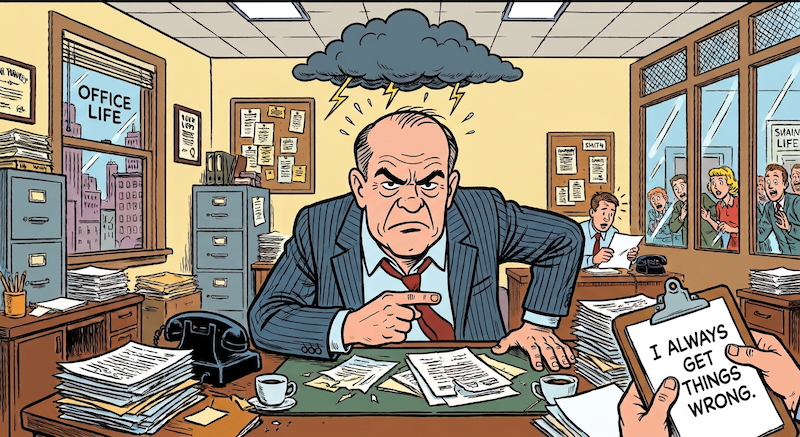
Consider the adult who is spoken to critically by a boss. The worker may be able to identify the emotional response quite clearly:
“I felt anxious.”
“I felt humiliated.”
“I became angry.”
“I wanted to disappear.”
But hidden in the shadows may be something even more important — a meaning pre-reflectively attached to those feelings.
I am not good enough.
I don’t matter.
I always get things wrong.
People will leave when I disappoint them.
I am unlovable.
My voice doesn’t matter.
These meanings may have been quietly carried for decades. And unless they are explored, understood and brought into relationship, a person can continue circling the same painful emotional loop without fully understanding why.
This is why emotional regulation, although important, may not by itself be enough.
We can teach people to breathe through anxiety. We can help them recognize anger. We can teach mindfulness, grounding and coping strategies. But if underneath the regulated feeling remains the deeply held conviction “I am not enough,” then the original wound remains largely untouched. The next criticism, rejection, disappointment or loss may reactivate it.
The situation may change. The people may change. The circumstances may change. But the meaning remains painfully persistent.
This is where trauma can begin to interfere not simply with emotional comfort, but with the ability to live a flexible and creative life.
Trauma restricts our choices
A flexible life requires the capacity to imagine possibilities.
It allows us to take risks, tolerate uncertainty, recover from disappointment, enter relationships, leave relationships that are harmful, pursue opportunities and imagine ourselves becoming something we have not been before. But old meanings can quietly narrow those possibilities.
A person may say:
“I don’t know why I can’t take the next step.”
“I have always wanted to do this, but something stops me.”
“Why am I so afraid to put myself out there?”
“Why do I keep choosing people who don’t really see me?”
“Why do I give up just when something begins to matter?”
These are important moments in therapy. Because somewhere underneath the apparent fear may be a part of the self that became frozen long ago. The frozen part is not simply the memory of what happened. It may be the meaning made from what happened.
A child repeatedly ignored may not simply remember being ignored. The child may come to experience: I don’t matter.
A child repeatedly criticized may not simply remember criticism. She may begin to agree with the messaging and carry: Something is wrong with me.
A child whose feelings were dismissed may come to believe: My feelings are too much for other people. I need to stay small.
And a child who repeatedly reached for comfort and found no one emotionally available may eventually stop reaching altogether.
The adaptation once protected the child. But years later, it imprisons the adult.
Warming the frozen parts
Flexibility begins to emerge when these frozen parts of our experience are gradually warmed into consciousness.
This requires more than simply correcting an irrational thought. Painful meanings that were formed relationally often need to be understood relationally.
The person needs an experience in which fear, shame, grief, anger and loneliness can be expressed and held within a context of emotional understanding.
When another human being can remain present with what once had to be endured alone, something begins to shift.
The question becomes less: “How do I stop feeling this?” and more: “How did I come to understand myself this way?”
That is a very different therapeutic journey and one that cannot be taken alone. A collaborative, empathic other human being who holds these painful questions can help facilitate the very freedom that such courage brings. It allows us to recognize that some of the beliefs we have carried as truths about ourselves may be meanings formed under painful circumstances.
And meanings can both felt and reconsidered, bringing a more healthful and integrated sense of sense.
From triggered living to creative living
When pain, fear, loneliness, shame and other difficult affects are shared and contextually understood, the grip of old trauma states can gradually loosen.
The boss’s criticism can become criticism rather than proof of inadequacy.
A partner’s disappointment can become disappointment rather than evidence of one’s being unlovable.
A mistake can become a mistake rather than confirmation of failure.
A rejection can hurt deeply without becoming a verdict on one’s worth.
This is where emotional flexibility begins.
Through empathic attunement, persistence, curiosity and the careful unpacking of meanings that have remained hidden for years, the negative beliefs attached to old wounds can gradually lose their authority.
Triggers may still occur. We remain human, and our histories remain part of us. But they no longer must dictate what happens next. And perhaps this is one of the most important goals of trauma treatment — not simply to become less triggered, but to become free.
Free to pause.
Free to reflect.
Free to reconsider what an experience means.
Free to respond differently.
Free to take risks.
Free to create.
Ultimately, free to discover ways of being in the world that were simply unimaginable when so much energy was devoted to protecting the wounds of the past.
Related content:
— AI illustration via Gemini